The Pressure Is Gone. The Joy Remains.
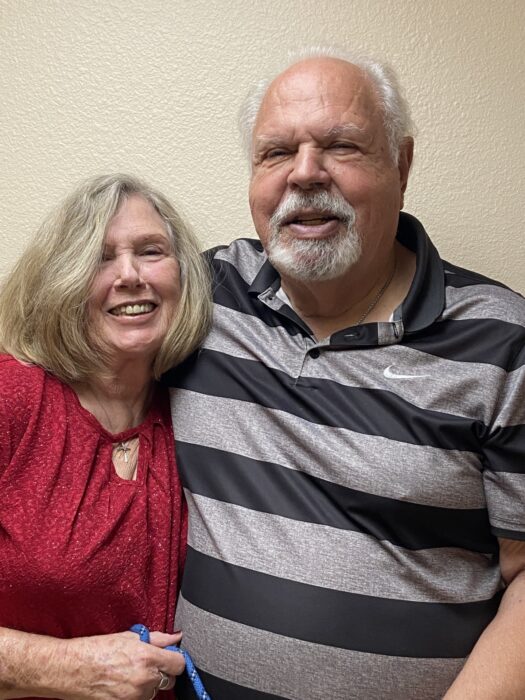
Sal will be the first to tell you he did not think he was ready.
He had spent forty years keeping the lights on — literally — as a utility industry professional in New York and Arizona. He had retired early to care for his wife, Lynne. He had fixed, maintained, managed, and worried over every detail of their home and life for decades. Moving to a senior living community was not something he could picture for himself. He was not that guy.
Then he had a stroke. And he listened.
“I got a message from God who used my stroke to tell me that it was time,” Sal says. “Now I appreciate it, because it was time to stop carrying everything.”
Lynne had a similar awakening, though hers came differently, and earlier, and with the particular grace of someone who has learned to choose joy on purpose.
New York Roots, Arizona Life
Sal was born in Sicily and came to America at six and a half years old. He grew up in New York City, then on Long Island, before he and Lynne made the move to Arizona in 1981. Lynne’s childhood bounced between New York and Florida. She came back to New York at thirteen, and when she and Sal eventually headed west, they put down roots in the East Valley for nearly four decades. They’ve been married 61 years.
Sal started his career as a groundman, assisting linemen, and worked his way up until he discovered that he was afraid of heights, so he cut the goal of being a lineman short! He pivoted to substation maintenance, then operations, eventually overseeing the generation and distribution of power to companies across the region. Forty years in the industry, and he still talks about it with the matter-of-fact pride of someone who understood exactly what the work meant.
Lynne was working as an office manager when she was diagnosed with multiple sclerosis. As the disease progressed, she made a decision that surprised even Sal: she enrolled in beauty school. He thought she was out of her mind. She did it anyway, and built a sixteen-year career in corrective pedicuring — a specialty precise enough that clients called from across the country, and beyond, to make sure their appointments were locked in.
“I’ve always believed you figure out what you can do,” she says, “and you do it.”
Choosing Happy
Lynne and Sal have two sons and a daughter. They lost their daughter to cancer six years ago. It is a grief that does not leave, but Lynne holds it with a particular clarity.
“You can make the choice to be sad or happy,” she says. It is not a dismissal of loss but rather a philosophy she has earned.
They have six grandchildren and recently learned a great-grandchild is on the way. The family is spread across the country but are all close in the ways that count.
After retiring, Lynne began volunteering at Camelot Therapeutic Riding, working with children who have serious disabilities and illnesses, helping them experience the freedom that comes from horseback riding. Then she had three strokes. Suddenly, she went from volunteer to student. Today, she is 81 years old and still riding once a week.
Sal, who had no interest in horses, eventually got dragged along. He now volunteers there for maintenance. That is how things tend to go with Sal — he says he is retired and likes being retired, and then he quietly shows up to help.
Eight Communities. One Decision.
When it came time to think about senior living, they were thorough. Lynne visited eight different communities. Sal joined her for two.
From the very first tour of Sierra Winds, people stopped to talk to them. Not staff on assignment but residents, in the hallways, just stopping to say hello. The warmth was immediate and specific enough to notice. Sierra Winds also checked practical boxes that mattered: it is a 501(c)(3) nonprofit, which carries its own assurance. There is a workshop for Sal. It was also the only community on their list with a full chapel.
When Lynne walked in, she felt it. When Sal walked in, he felt it too — though he was not ready to say so yet.
Then came his stroke. And suddenly the question was no longer whether he could picture this life. It was whether he was willing to stop waiting.
“My body told me to do something,” he says. “So I listened.”
What the Pressure Costs and What Happens When It Lifts
Lynne and Sal have been at Sierra Winds for almost a year now. In that time, something shifted in Sal that he did not fully anticipate.
“This is the first time in my life I haven’t felt the pressure to do everything,” he says. The handyman role, the bills, the maintenance, the endless forward motion of managing a household are gone. He retired at 60 because the job was affecting his health, and Lynne’s health had taken a turn then too. Even then, the pressure did not stop. It followed him home.
At Sierra Winds, it stopped.
“I can focus on her now,” he says about Lynne. “I don’t have to worry about anything else.” For a man who has spent the better part of his life making sure everything works — the grid, the house, the family — that large shift took a couple of months to fully settle into, to exhale, and to say, this is home.
For Lynne, the impact has been just as real, and more visible. She was unhappy in her house because isolation has a weight of its own, especially when health challenges make it harder to get out. At Sierra Winds, she leaves her apartment and the community is already there. No cooking. No cleaning. Everywhere she goes, someone is glad to see her.
“You cannot stay in a dark place here,” she says. “It’s just not possible.”
She sits on the activities committee, the grounds committee, and the welcome committee. She joined the Juliette Club — a group of women who go out to dinner together — and loves it. Lynne and Sal both walk the grounds once a month as part of their committee responsibilities, reporting anything that needs attention. Sal found his way to that committee through Lynne. too. Of course he did.
And then there is Carter, their large, white goldendoodle service dog, and quite possibly Sierra Winds’ most effective social ambassador. “My husband asks, ‘Who do you NOT know here?'” Lynne laughs. Carter makes sure the answer is “no one.”
When Lynne was recently hospitalized, cards arrived from Sierra Winds friends, people she has known for less than a year. “It’s a real family and community,” she says.
What They Would Tell You
Lynne does not hedge. “Do it now. Do it sooner rather than later. Do it while you’re young enough to enjoy everything here. I wish we had done it even sooner.”
Sal speaks more carefully, because he knows the person sitting on the fence. He was that person.
“A lot of people think the way I did,” he says. “You don’t realize how much you’re carrying until you put it down. The house, the money, the physical upkeep…and then you don’t have to anymore. There’s a health center right here for emergencies. It’s a tough thing to change your mind about. I know how it feels.”
He pauses.
“For someone like me, they need to experience it. It took a couple of months to fully relax and say: this is home.”
He got there. And now he would not go back.